

8. September 2022
Why Waterproof Socks Fail and How DEXLOK® Fixes It
Updated: March 2026
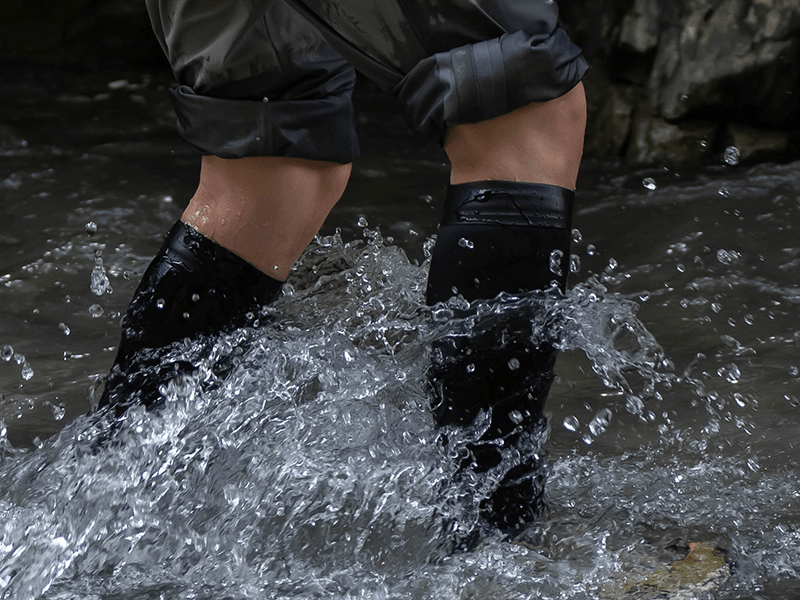
Waterproof socks are often misunderstood – not because the technology fails, but because expectations do.
Most waterproof socks rely on a membrane that prevents external water penetration. However, real-world use introduces a different challenge: Water entering from above.
What Waterproof Socks Really Do – What They Don’t
How Waterproof Membranes Work
Waterproof socks use a membrane layer that:
- Blocks external water (rain, mud, splashes)
- Allows sweat vapour to escape
Learn more about the waterproof sock construction → DexShell Waterproof Sock Technology
Waterproof Socks Don’t Fail – Expectations Do
All standard waterproof socks share this structure:
- Waterproof membrane ✔
- Open cuff ❗
Waterproof socks don’t fail in the way most people assume. Instead, they reach a limitation – once water enters from the top opening, the membrane will hold the water. In real-world conditions, like stepping into a stream or deep puddle – water flows over the cuff and into the sock. This is the #1 reason users don’t believe waterproof socks work.
This limitation is not unique to one brand – it’s inherent to all open-cuff waterproof socks. Addressing it requires not just a better membrane, but a rethink of how the sock interfaces with the leg.
Introducing DEXLOK® – A Sealed Cuff System
By integrating a cuff seal structure into waterproof socks, it reduces the likelihood of water entering from above during intermittent exposure, such as river crossings or wet terrain.

How the Cuff Seal Works
- A close-fit water resistant cuff creates a barrier against downward water flow
- Works together with the waterproof membrane in fabric
- Reduces water ingress during movement
Real Benefit in Use
- Freezing river crossings
- Wet terrain hiking
- Splash-heavy environments
Performance Comparison
In real-world use, the difference becomes clear:
- Standard waterproof socks protect against external splashes and shallow exposure.
- DEXLOK® extends protection during intermittent immersion, where water would otherwise enter from the top.
The Core Difference: Most waterproof socks protect from outside-in, while DEXLOK® is designed to also reduce top-down water ingress.
Note: While DEXLOK® Wading Pro Sock significantly improves resistance to water entering from the top, it does not make the sock fully submersible over prolonged immersion like a drysuit .
Why This Innovation Matters
Solves the #1 Waterproof Sock Limitation
Top-entry water is the most common failure point.
Extends Real-World Usability
From light rain to unpredictable wet environments
A Step Forward in Waterproof Sock Design
DEXLOK® moves waterproof socks from: Passive protection → Active system design
Waterproof sock performance is not defined by the membrane alone, but by how the entire system handles real-world conditions. DEXLOK® represents a shift from “waterproof fabric” to “water management design” – addressing one of the most overlooked limitations in the category.
Explore more about → Patented DEXLOK® Waterproof Sock Technology